
Salesforce for Real Estate: The Complete 2026 Guide
For Real Estate Developers and Property Management Companies
How developers and property managers run inventory, bookings, payment plans and leases on one Salesforce CRM, what a real estate layer adds to plain Salesforce, and what it costs over five years.

Key Takeaways
- Salesforce is a strong foundation for real estate, but out of the box it has no concept of projects, units, bookings, payment plans or leases.
- Developers and property managers close that gap in one of two ways: custom development on Salesforce, or a ready-made real estate CRM built on Salesforce.
- Licence price is only one part of the cost. Over five years, custom build, slower adoption and upkeep at every Salesforce release usually cost more.
- Teams adopt a CRM when it shows them their own world: units, bookings and leases, not generic leads and deals. AI only helps when it can read that data.
- PropertyFlex is a real estate CRM built on Salesforce that runs sales, leasing, broker and customer portals, and post-sale operations on one shared data model, with clients seeing a 25% increase in lead conversions.
Salesforce for real estate can run a developer’s or a property manager’s business, but only once it knows what a unit, a booking and a lease are. Property firms that already trust Salesforce with customer data often ask how far it can go. That depends on whether you sell, lease or do both.
Most Salesforce for real estate guides are written for brokers: listings, comps and commission splits. Developers and property management companies have a different problem. They sell and lease inventory they own or manage, across projects that run for years, with payment schedules, contracts and tenant requests attached to every unit. This guide explains how Salesforce handles that work, what a real estate layer adds, what it costs over five years, and how to choose the right setup in 2026.
Where Salesforce for Real Estate Is Strong, and Where It Stops Short
Salesforce earns its place when a property business needs a single record of every customer, interaction and transaction, shared by sales, leasing, finance and service teams. These strengths stand out:
One Customer Record
Across marketing, sales and service, so a buyer who becomes a tenant or a repeat investor is never re-entered.
Automation
Flow, approvals and assignment rules that remove manual follow-ups.
Reporting and Dashboards
Leadership can trust them because they read from the same data the teams work in.
An Ecosystem
AppExchange apps, integrations and AI features such as Agentforce.
Security and Scale
Suited to multi-project, multi-country portfolios.
The Gap
No standard objects for projects, units, bookings, payment plans or leases.
Standard Salesforce objects (Leads, Accounts, Opportunities, Cases) were designed for generic B2B selling. A real estate developer needs objects for projects, buildings, floors, units, bookings, payment milestones and leases. Without them, teams fall back on spreadsheets for inventory and finance, and the CRM becomes a contact list.
What Developers and Property Managers Need From a Salesforce Real Estate CRM
Before choosing how to deploy Salesforce, map the operations the CRM must run. For most developers and property management companies, the list looks like this:
Project and Unit Inventory
Live availability, pricing and unit status to avoid double booking.
Lead Capture From Every Channel
Portals, website, events, brokers and walk-ins in one queue with clear ownership.
Bookings and Reservations
Hold a unit, collect a deposit and move to contract through a controlled workflow.
Payment Plans and Collections
Milestone-based instalments that finance and sales both track.
Broker and Channel Partners
Registration and tracking for partners who sell a large share of units.
Leasing Workflows
Enquiry, viewing, booking, payment, contract and renewal for every asset type.
Tenant Service
Maintenance requests, complaints and move-in/move-out checks with SLAs and history.
Management Reporting
Sales velocity, collections, occupancy and pipeline by project.
Standard Salesforce covers the customer and pipeline layer well. The real estate layer on top (inventory, bookings, payment plans, leases) is where a real estate specific build or product is needed. For a closer look at the sales side, see Salesforce for real estate developers and home builders.
Plain Salesforce vs Salesforce With a Real Estate Layer
Both run on the same Salesforce platform, with the same security, automation and AI. The difference is what your teams find when they log in on day one, and who keeps the real estate logic working after every Salesforce release.
| What You Need | Salesforce Out of the Box | Salesforce With PropertyFlex |
|---|---|---|
| What users work with | Leads, accounts and opportunities, relabelled for property | Projects, properties, units, bookings and leases |
| Unit inventory | Built as custom objects by your partner | Live availability by project, floor and unit, with holds and releases |
| Launch-day control | Depends on custom rules | Channel-wide controls so a unit can only be committed once |
| Payment plans and collections | Custom build or a separate finance tool | Instalments created from the booking, tracked by sales and finance |
| Post-sale changes | Transfers and upgrades need custom workflows | Transfers, upgrades, joint ownership and handover on the unit record |
| Leasing lifecycle | Built from scratch | Enquiry to lease, renewals, termination, settlement and case management |
| Broker and customer portals | Experience Cloud sites to design and build | Broker registration, CIL tracking and buyer and tenant self-service |
| AI answers | Generic, until real estate data exists in Salesforce | Answers from live inventory, payment plans and leases |
| Upkeep at Salesforce releases | Your team or partner retests all custom code | The real estate product is maintained by the PropertyFlex team |
See the difference on your own projects. We demo PropertyFlex on your units, payment plans and leases.
Book a Demo →Property Sales on Salesforce: From First Enquiry to Handover
With a real estate data model in place, Salesforce runs the developer sales cycle end to end: leads routed by project and language, units held and booked against live inventory, the SPA and payment plan generated from the booking, collections tracked by instalment, and handover, transfers and upgrades kept on the unit record.
The value is not any single step. Every step writes to the same customer and unit record, so nobody reconciles spreadsheets at month end.
Leasing and Tenant Management on Salesforce
Property management companies and leasing teams work in shorter, repeating cycles, so speed and renewals matter more than one-off transactions. On Salesforce, a leasing workflow runs from enquiry, booking and payment to the lease contract and case management, then loops back at renewal.
A mobile app for move-in and move-out inspections completes the loop, so condition reports, photos and handover notes sit on the same tenant record as the lease. Commercial and retail operators also need multi-unit enquiries, split and merged units, and corporate tenant profiles on one record. For mixed-use portfolios, running sales and leasing for every asset type in one CRM avoids separate systems per asset class.
Why Teams Adopt It: What Each Role Sees on Day One
A CRM fails when people go back to spreadsheets. Adoption comes from opening the system and finding exactly what the job needs, in the language of real estate. This is what each person works with in PropertyFlex from the first day, inside and outside your company:
Available units by project, price and view, with the buyer’s preferences beside them.Shares an offer, books the unit and sends the SPA without leaving the record.
Pipeline by project and agent, discount approvals waiting, and units on hold about to expire.Approves from a phone and follows launch-day sales as they happen.
A portal to register, submit Client Introduction Letters and see live availability.Tracks every referral and its status, so commission questions have an answer.
Instalments due and overdue by project, receipts and statements of account.Works from the same payment plan the sales team sold.
Vacant units matched to tenant preferences, leases up for renewal and expiring documents.Moves an enquiry to a signed lease in one pipeline.
Open tenant requests and notices, with move-in and move-out inspections on mobile.Every case sits on the tenant and unit history.
A self-service portal for payments, receipts, contracts and documents.Raises a request or renews without a phone call.
Sales, collections, occupancy and pipeline across every project on live dashboards.No month-end spreadsheet consolidation.
Agentforce for Real Estate: AI That Knows Your Salesforce Data
Agentforce is Salesforce’s AI agent layer, and it now sits at the centre of the Salesforce roadmap. An AI agent is only as useful as the data it can read. If inventory and payment plans live in spreadsheets, the agent cannot quote an available unit or a balance due. When that data lives in Salesforce, the agent can act on it:
$980KAvailableVilla 115 · 3 BR
$1.02MAvailable
Illustrative example of the PropertyFlex AI agent, based on the flow shown in our UAE customer story.
Lead Response
Answers portal and website enquiries instantly, qualifies budget and timing, and books site visits.
Tenant Self-Service
Tenants check payment status, raise maintenance requests or ask about renewal terms at any hour.
Sales Assistance
Summaries of a buyer’s history, suggested next steps and draft follow-up emails inside the record.
Offer and Payment Plan
Once a unit is chosen, the agent builds the offer and payment plan from the same data your team uses.
That is why the real estate data model comes first and AI second. With PropertyFlex, the data is already structured for the agent to use. Agentforce itself is licensed by Salesforce, so include it in your cost comparison.
Watch the AI agent answer from live inventory. See it book a viewing and build an offer in a live demo.
See the AI Agent Live →Build or Buy: Two Routes to a Real Estate Layer on Salesforce
This is the decision that shapes cost, timeline and long-term ownership.
| Factor | Custom Salesforce Build | Ready-Made Real Estate CRM on Salesforce |
|---|---|---|
| Real estate data model | Designed from scratch | Projects, units, bookings, payment plans and leases already built |
| Time to go-live | Longer: every process is designed, built and tested | Shorter: configuration of proven processes |
| Fit to unique processes | Maximum | High, with configuration and extensions |
| Maintenance | Your team or partner owns all custom code | Product updates are maintained by the vendor |
| Best for | Highly unusual business models | Developers and property managers with standard real estate workflows |
Many firms start custom, then discover they have rebuilt a real estate product with none of the upkeep handled for them. A ready-made product on Salesforce keeps the platform’s flexibility while removing years of design work.
What Drives the 5-Year Total Cost of Ownership
Licence fees are the easiest number to compare and the least useful on their own. Salesforce user licences cost the same on either route. What changes the five-year total is everything around them:
Custom Build on Salesforce
- Year 1: buildDesign, develop and test inventory, bookings, payment plans and leases from scratch.
- Year 1: slower adoptionTeams learn generic screens while gaps are fixed, so spreadsheets stay in use longer.
- Every release: retestingSalesforce ships three major releases a year, and all custom code must be checked each time.
- Years 2 to 5: change requestsNew projects, asset types and business lines mean more custom modules.
- Risk: key-person dependencyThe logic lives with the people who built it.
Ready-Made Layer With PropertyFlex
- Year 1: configureReal estate processes already exist, so effort goes into your projects, rules and integrations.
- Year 1: productive soonerUsers see units, bookings and leases from day one.
- Every release: maintainedThe real estate product is kept current by the PropertyFlex team.
- Years 2 to 5: grow on one recordAdd projects, leasing and post-sale on the same customer and unit data.
- PaybackPropertyFlex clients have seen a return on investment in under 12 months.
Get a 5-year comparison on your own numbers. Ask each partner to price licences, the real estate layer, services and five years of upkeep separately before comparing quotes. The PropertyFlex team will model a 5-year cost comparison for your projects.
A Six-Step Rollout Plan for Salesforce Real Estate Projects
A successful implementation follows a clear sequence:
Discovery
Map sales, leasing, finance and service processes per project and region.
Data Model and Configuration
Set up projects, units, pricing, payment plans and lease templates.
Data Migration
Move contacts, inventory, bookings and active leases from spreadsheets or legacy systems.
Integrations
Listing portals, web-to-lead, ERP (Oracle, SAP, NetSuite), DocuSign or Adobe Acrobat Sign, WhatsApp, SMS, telephony, payment gateways and KYC.
Training and Adoption
Role-based training for sales, leasing, finance and management.
Go-Live and Support
Close support in the first weeks after launch, then ongoing improvements.
Timelines depend on the number of projects, integrations and the volume of historical data. Using a ready-made real estate product usually shortens steps 2 and 3 the most. For a walkthrough of a real rollout, watch the Salesforce CRM for Real Estate Developers webinar.
How PropertyFlex Makes Salesforce Work for Real Estate
PropertyFlex is a real estate CRM built on Salesforce for developers, leasing firms and property management companies. It adds the real estate layer that standard Salesforce lacks, so teams work in one system from first enquiry to handover and through every lease renewal.
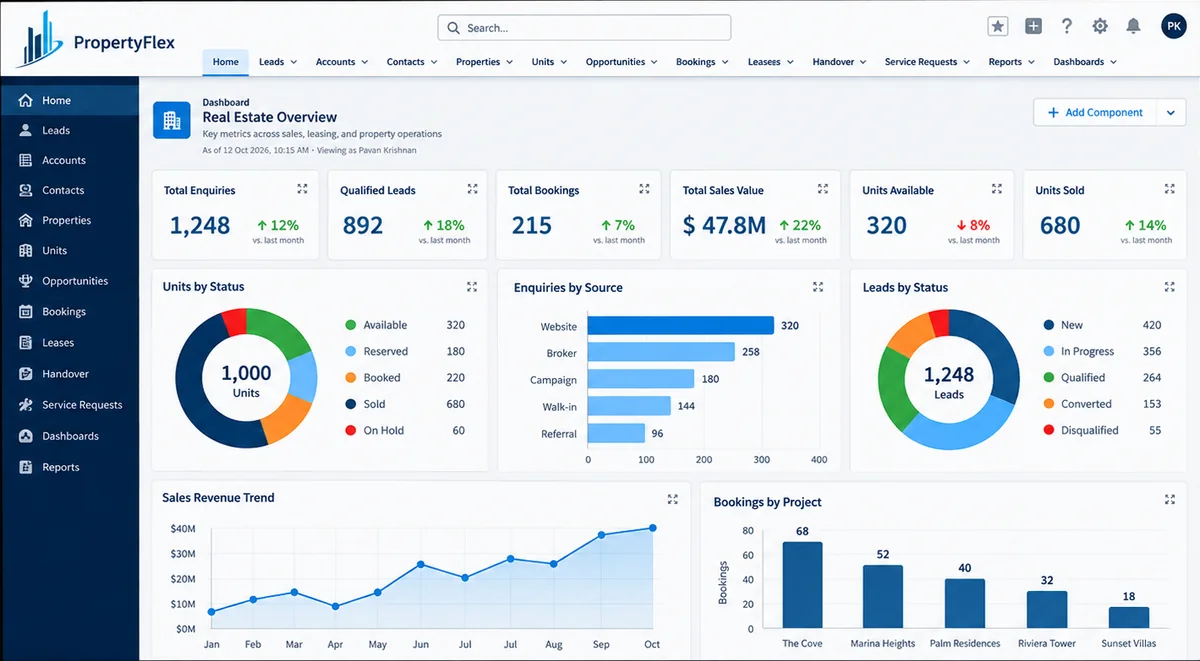
Sales and Leasing on One Record
Inventory, bookings, payment plans, leases and post-sale changes share one customer and unit data model.
Built on the Full Salesforce Stack
Sales Cloud, Service Cloud, Experience Cloud and Agentforce.
Fits Your Existing Org
Can be added to an existing Salesforce org; the team plans how your data, automation and integrations carry over.
Proof: How a UAE Developer Sold 1,200+ Units on Salesforce
Starting with no legacy systems and a nine-month runway, a leading Abu Dhabi residential developer built a fully digital buyer journey with PropertyFlex at the centre of its Salesforce org.
The real estate experience and value added by the PropertyFlex team across all of our applications, including integrations, is commendable.Head of Digitalization Sales, Real Estate Developer, Abu DhabiRead the Customer Story →
Why Metadata Technologies Builds PropertyFlex
PropertyFlex is built by Metadata Technologies, a Salesforce Partner that works only in real estate. The product carries two decades of real estate CRM work: how project launches run, how payment plans are structured, and what happens to a unit after it is sold or leased.
100% Real Estate Focus
Developers, landlords and property management companies are the only customers the team serves. PropertyFlex brings that experience to Salesforce.
We Maintain What We Build
The real estate features are kept current by the PropertyFlex team after go-live, not left to your IT team.
Shown on Your Own Data
Demos run on your projects, units and payment plans, so you see the fit before you commit.
Questions to Ask Any Salesforce Real Estate Partner
Whoever you shortlist, these questions separate a real estate specialist from a general Salesforce partner:
Who maintains the real estate features after go-live?
What good looks like: a named team that keeps the real estate features current with every Salesforce release, not your IT team.
Can we see it working on our own projects and units?
What good looks like: a demo on your own projects, units and payment plans, not a generic sandbox.
How is inventory protected on launch day?
What good looks like: controls across every channel so a unit can only be committed once, at any sales pace. PropertyFlex has these built in.
What will this cost over five years, not just year one?
What good looks like: a 5-year view that includes build, adoption and upkeep, not just licences. PropertyFlex models this on your numbers.
Can our existing Salesforce org and integrations stay?
What good looks like: a clear plan for how your data, automation and integrations carry over. PropertyFlex can be added to an existing org.
Choosing the Right Salesforce Setup for Real Estate
Salesforce for real estate works best when the platform’s strengths meet a data model built for property. Map your sales, leasing and post-sale processes first, compare build and buy on a five-year cost, and only then add AI on top. For most developers and property management companies, a ready-made product gets them live faster, keeps teams in the CRM, and keeps upkeep off their plate.
See PropertyFlex on Your Own Projects
See PropertyFlex running on your own projects and units, with a 5-year cost comparison modelled on your numbers.
Salesforce for Real Estate: Frequently Asked Questions
Is Salesforce a Good CRM for Real Estate Developers?
Yes, when it is extended with a real estate data model. Salesforce gives developers a single customer record, automation and reliable reporting, but it needs objects for projects, units, bookings and payment plans to run off-plan and ready-unit sales. PropertyFlex adds that layer on Salesforce, so developers get the platform’s strengths without building the real estate logic from scratch.
Can Salesforce Manage Unit Inventory and Availability?
Not with standard objects alone. Standard Salesforce tracks products and opportunities, not buildings, floors and units with live status. A real estate CRM built on Salesforce, such as PropertyFlex, adds project and unit inventory so sales teams see availability and pricing in real time and avoid double bookings.
Can Salesforce Handle Off-Plan Payment Plans and Collections?
It can when payment milestones are linked to the booking and the unit. In PropertyFlex, the payment plan is created from the booking, so sales, finance and management track the same instalments, and overdue payments surface on dashboards early.
Can Salesforce Be Used for Leasing and Property Management?
Yes. Salesforce’s case management and automation suit leasing well once leases, rent schedules and units are modelled. PropertyFlex covers the leasing journey from enquiry, booking, payment and contract through to case management, with a mobile app for move-in and move-out inspections.
Does a Developer Have to Customise Salesforce Before Using It?
Almost always. The question is whether to build that customisation yourself or start from a real estate product. Custom builds offer total control but take longer and leave your team maintaining the code. A ready-made real estate CRM on Salesforce shortens the timeline and keeps product updates with the vendor.
What Sets the Go-Live Timeline for a Salesforce Real Estate Project?
It depends on the number of projects, integrations and the amount of data to migrate. Starting from a real estate product rather than a blank org usually shortens configuration and testing the most, because core processes such as bookings, payment plans and leases already exist.
Can We Add PropertyFlex to Our Existing Salesforce Org?
PropertyFlex is built on Salesforce, so it works alongside the Salesforce tools your teams already use. The PropertyFlex team reviews your current org during discovery to plan how existing data, automation and integrations carry over.
How Does AI (Agentforce) Help Real Estate Teams on Salesforce?
Agentforce can answer enquiries instantly, qualify leads, book site visits, support tenants with self-service and summarise customer history for sales teams. It works best when inventory, bookings, payments and leases already live in Salesforce, which is what a real estate CRM like PropertyFlex provides.
Can Salesforce Manage Brokers and Channel Partners for Real Estate?
Yes, through a partner portal on Experience Cloud. PropertyFlex includes broker registration, approval and referral tracking, plus Client Introduction Letter tracking, so developers know which broker introduced each buyer and avoid commission disputes.
Does PropertyFlex Integrate with ERP, E-Signature and Listing Portals?
Yes. PropertyFlex connects to ERP and accounting systems such as Oracle, SAP and NetSuite, e-signature tools such as DocuSign and Adobe Acrobat Sign, WhatsApp, SMS, call centre telephony, payment gateways, listing portals, web-to-lead forms and KYC services. Integrations not on the standard list are built to requirement.
How Should We Compare the Cost of Salesforce Real Estate CRM Options?
Compare five years, not year one. Salesforce user licences are the same on either route, so the difference comes from building the real estate layer, how quickly teams adopt it, retesting custom code at each Salesforce release, and change requests as you add projects. PropertyFlex models a 5-year cost comparison on your own numbers, and its clients have seen a return on investment in under 12 months.